
Strong messages on enhancing competitiveness and attracting investment to Greece through targeted initiatives and a unified direction across all stakeholders
Athens, April 27, 2026 — The panel discussion on clinical research at the 11th Delphi Economic Forum concluded with great success, highlighting the prospects for strengthening Greece’s position on the European map. The session titled “Clinical Trials in Europe: Competitiveness, Access and Innovation,” held on the initiative of HACRO, made it explicitly clear that Greece is entering a new, more mature phase, marked by strong prospects for attracting investment in clinical research.
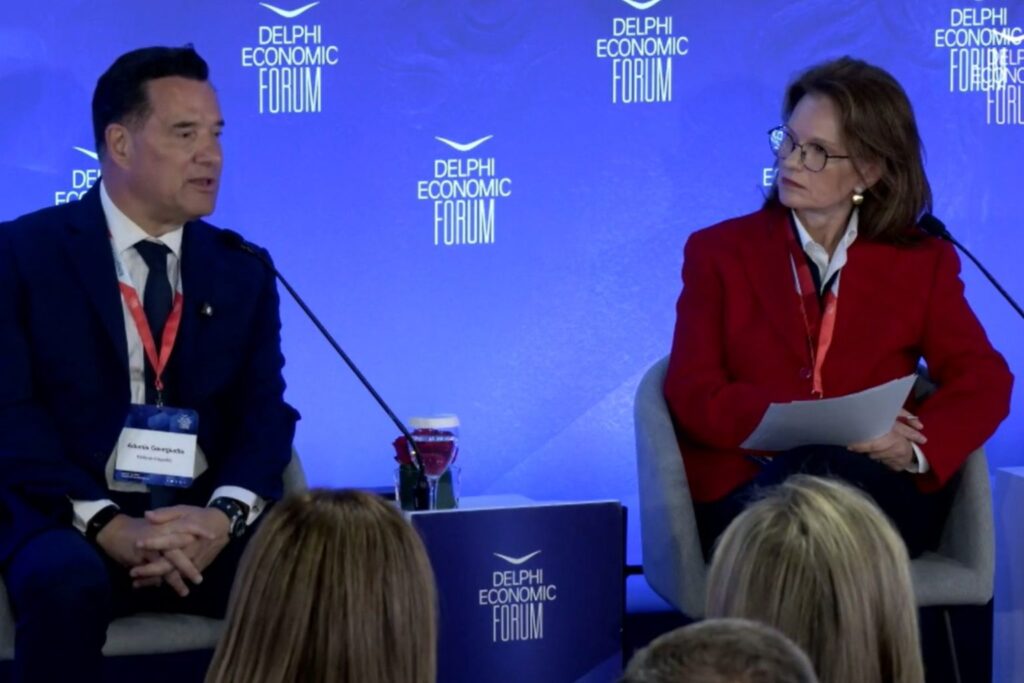
At her speech, HACRO President Evangelia Koraki, who also moderated the discussion, put forward a clear and assertive vision for clinical research as a strategic driver of the country’s growth. She emphasized that this is one of the few sectors where Greece can simultaneously enhance the quality of patient care, attract foreign investment, and leverage its high-caliber scientific talent, forging a direct link between health, innovation, and the economy.
Ms. Koraki noted that in recent years Greece has built a more mature and credible foundation for growth, driven by concrete institutional reforms that have enhanced the speed, transparency, and predictability of the system. She stressed, however, that the next phase demands a stable and genuinely competitive environment, characterized by consistent strategic planning and meaningful coordination among all stakeholders. As she underscored, clinical research is part of a broader ecosystem in which incentives, innovation, and patient access are interconnected; the challenge now is to translate this dynamic into a coherent and sustainable development model for the country.
Particularly impactful were the remarks of Minister of Health, Adonis Georgiadis , who presented a suite of targeted initiatives aimed at strengthening clinical research and improving Greece’s competitiveness. A key measure announced was the integration of a dedicated field within the National Electronic Health Record (NEHR) to allow patients to declare their willingness to participate in clinical trials, as a move designed to strengthen the connection between patients and research and to enhance the country’s attractiveness to international investors. The Minister also highlighted that the development of clinical trials already serves as a performance criterion in the evaluation of hospital administrations and raised the possibility of increasing the clawback offset for research expenditures to 50%, noting that the feasibility of this measure would be examined in the coming days.
The Minister reported that Greece has already recorded a notable rise in applications for new clinical studies, reaching 272 in 2025, up from 212 in 2024, reflecting the positive direction the country is heading. The goal, he emphasized, is to further strengthen the country’s standing on the European clinical trials landscape, with an ambition to move from its current 14th position into the top ten. He placed particular emphasis on attracting Phase I studies, which carry higher investment value, noting that Greece currently draws primarily Phase II and Phase III trials.
Significant contributions came from all panelists, each shedding light on critical aspects of the clinical research ecosystem. Ms. Olga Balaoura, Governor of the 1st Health Region of Attica, highlighted the transition toward a more organized and competitive environment within hospitals, with the aim of establishing a unified clinical trials “hub”. In this framework, the 1st Health Region plays a coordinating role by training staff, fostering a culture of collaboration, and establishing quality benchmarks. She stressed that clinical studies are not a peripheral activity within hospitals, but a structural component of healthcare delivery within the national health system.
The President of the National Organization for Medicines (EOF), Mr. Spyridon Sapounas, announced that by the end of 2026, EOF expects to onboard 50 new staff members and to launch the National Biomedical Research Registry, which will enable comprehensive monitoring of all clinical studies within its regulatory remit. He further noted that Greece has submitted applications to participate in two new European programs: FACT EU, focused on strengthening the evaluation and inspection of clinical trials, and SUPPORT, dedicated to non-commercial clinical trials.
Representing the academic community, Professor Meletios-Athanasios Dimopoulos drew attention to the challenges Europe faces in terms of speed and bureaucracy relative to more competitive markets such as China, calling for simplification of procedures and enhanced incentives. He also pointed to the relatively low number of clinical trials conducted at major Greek hospitals, citing Evangelismos as a prime example, as indicative of the significant room for improvement that remains.
Mr. Olympios Papadimitriou, President of SFEE (the Hellenic Association of Pharmaceutical Companies), addressed the limited uptake of Phase I clinical trial funding in Greece and underlined the critical importance of the speed–quality–incentives triad in boosting competitiveness. He also called for stronger investment incentives, including further utilization of the clawback offset against research expenditures, arguing that creating a more innovation-friendly environment is essential to attract investment.
Ms. Memi Tsekoura, President of the Greek Patients’ Association, emphasized that simply making a medicine available on the market is not enough and that what truly matters is ensuring real and timely access for patients. She also announced that, in order to address fear and lack of awareness surrounding clinical trials, the Association, together with HACRO and the Athens Medical Society — is launching a public awareness campaign under the auspices of the Ministry of Health.
A common thread running through all contributions was the recognition that clinical research constitutes a fully integrated ecosystem, where innovation, incentives, and patient access to cutting-edge therapies are strongly interrelated.
HACRO continues to play a leading role in shaping a modern and credible framework for the development of clinical research in Greece, actively bridging the State, the scientific community, and the pharmaceutical industry in pursuit of sustainable growth, increased investment, and improved patient access to innovation.